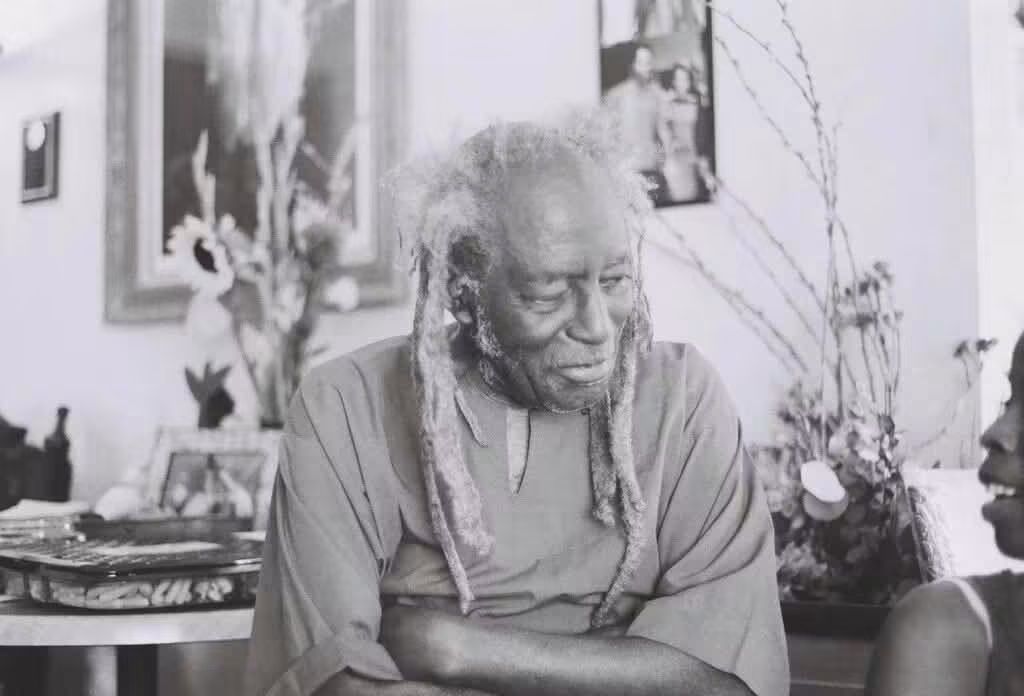
GEORGETOWN, Guyana, October 2026 — Eusi Kwayana, the teacher, freedom fighter, historian and elder statesman whose life ran through almost every chapter of modern Guyanese history, has died. He was 101.
Born Sydney Evanson King on April 4, 1925, Kwayana died on Saturday, October 10, at his home in Atlanta, Georgia, in the United States, according to a statement from Working People’s Alliance (WPA) co-leader Professor David Hinds. The WPA said it “joins with the Kwayana family” in announcing his death.
The People’s National Congress Reform (PNCR) and A Partnership for National Unity (APNU) announced his passing “with deep sorrow,” describing him as “a patriot, historian, elder statesman, and a towering figure in the political and social life of our nation.” The parties said he “served the People’s National Congress under the leadership of its founder, Linden Forbes Sampson Burnham,” and later “continued to serve the nation through the Working People’s Alliance, remaining a fearless and principled voice on matters of governance, justice, and national development.” Kwayana, they said, “was more than a politician; he was a teacher, a chronicler, and a conscience for our nation.”
This publication joins the nation in mourning a son of the soil who gave more than eight decades to the cause of a free, fair and united Guyana.
From Lusignan to Buxton
Kwayana was born in Lusignan on the East Coast of Demerara. His family moved to Buxton when he was seven, and that village shaped him for the rest of his life. He became a primary school teacher at just 15. In 1956 he founded County High School in Buxton and served as its principal. The school was later renamed Republic Cooperative High School.
Fighting Colonial Rule
In the 1940s he became active in village affairs. Around 1947, still known as Sydney King, he joined the group of activists led by Dr Cheddi Jagan that formed the People’s Progressive Party (PPP). When the PPP won the colony’s first election under universal adult suffrage in 1953, he took his seat in the legislature and became Minister of Communication and Works.
That government lasted only months. In October 1953 Britain suspended the British Guiana constitution and put the colony back under direct rule. In 1954 Kwayana was among the PPP figures the colonial authorities detained.
With Burnham and the PNC
After the PPP split in 1955, Kwayana broke with Jagan and later joined Burnham’s People’s National Congress. One account dates his move to 1958. The WPA says he served as Assistant General Secretary of the original PPP and as General Secretary of the PNC, and that he also edited the PNC newspaper New Nation. From 1964 to 1971 he chaired the National Land Settlement Committee, the Guyana Marketing Corporation and the Cooperative Insurance Committee.
He is widely credited with writing the words of the songs of all three major parties: the PPP’s “O Fighting Men,” the PNC’s “Battle Song” and the WPA’s “People’s Power.” The music for the PNC’s “Battle Song” was composed by the noted Guyanese composer Valerie Rodway.
ASCRIA and African Consciousness
In 1961 Kwayana co-founded the African Society for Racial Equality. In 1964, with Tacuma Ogunseye and others, he co-founded the African Society for Cultural Relations with Independent Africa (ASCRIA), which promoted African pride, dignity and culture. He served as its Coordinating Elder. Around this time he took the name Eusi Kwayana, Swahili for “Black Man of Guyana.”
By the early 1970s Kwayana and ASCRIA had parted ways with Burnham’s government. ASCRIA then reached across the racial divide, working with the Indian Political Revolutionary Associates to occupy vacant sugar estate lands.
The WPA and Walter Rodney
In 1974 ASCRIA became part of the newly formed Working People’s Alliance, and Kwayana became one of its co-founders. He sat in its collective leadership and worked closely with Dr Walter Rodney. After Rodney was assassinated in 1980, Kwayana recorded the struggle in Walter Rodney: His Last Days and Campaigns. In 1985 he was the WPA’s presidential candidate and was elected its only Member of Parliament. He also served as de facto editor of the party’s publications, Open Word and Dayclean. The WPA says he remained a member for 52 years, right up to his death.
Historian of His People
Kwayana wrote with the same honesty he brought to politics. His books include Next Witness, The Bauxite Strike and the Old Politics, Scars of Bondage, Guyana: No Guilty Race, Buxton in Print and Memory, Morning After and Genesis of a Nation: The Indo-Guyanese Contribution to Social Change. He was also a playwright. His play The Promised Land, performed by young people from Buxton, won Best Play in the youth category at the 1965 British Guiana Drama Festival.
Later Years
In 1971 he married Tchaiko Kwayana, an American Pan-Africanist and civil rights activist, in Georgetown. She died in 2017. Kwayana retired in 2002 and moved to California, and later lived in Atlanta.
A Nation’s Farewell
The WPA called him “one of Guyana’s priceless gifts to itself” and urged Guyanese to celebrate his life instead of mourning his passing. From the cane fields of the East Coast to the halls of Parliament, Eusi Kwayana asked Guyanese to see each other as one people. As the PNCR and APNU put it: “May his legacy of service, scholarship, and sacrifice continue to inspire us all.” May he rest in peace.


Leave a Reply