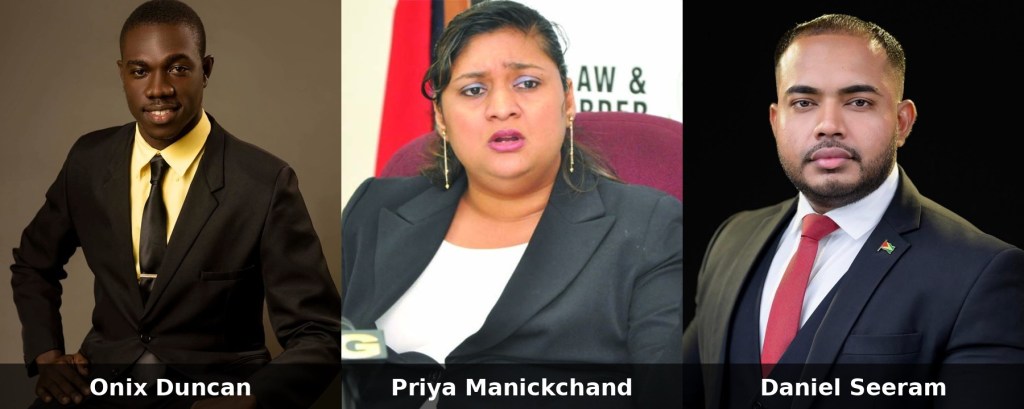
Priya Manickchand has been an attorney for 26 years and is a senior Minister in the PPP/C government, serving as Minister of Local Government and Regional Development since September 2025. It is therefore difficult to understand why she is asking Nigel Hughes to explain why Daniel Seeram has reportedly not been handed over to the Guyana Prison Service following his conviction for assaulting his former wife. Surely, she knows that the responsibility for executing a court order rests with the relevant State authorities and not the attorney representing the person concerned.
On October 2, Seeram was convicted by Magistrate Abigail Gibbs at the Sparendaam Magistrate’s Court of assault causing actual bodily harm against his former wife, Farzana Hamid, and ordered remanded pending sentencing on November 2. His attorney sought judicial review of the remand decision, but on October 5 High Court Judge Joy Persaud-Singh dismissed the application, finding no indication that the Magistrate had acted unlawfully, irrationally or outside her jurisdiction, and leaving the Magistrate’s order undisturbed. Yet, according to reports published on October 9, Seeram had still not been handed over to the Guyana Prison Service. Kiskadee Watch reported that day that the Prison Service’s Public Relations Officer, Rajiv Bisnauth, said Seeram had never been handed over to the prison authorities.
Why the delay?
The Magistrate made an order, and the High Court declined to interfere with it. Before the October 5 hearing, Seeram was reportedly held at the Sparendaam Police Station lockups, and Kiskadee Watch reported that Justice Persaud-Singh had ordered that he be held there pending that hearing. But what happened after the High Court’s decision? Was there a subsequent court order authorising his continued detention outside the prison system? If not, who decided that he should remain in police custody, what was the legal or administrative basis for that decision, and why was the transfer delayed?
These are questions that the relevant authorities should be able to answer. There may be a legitimate explanation, but that explanation has not been made clear to the public. When Kiskadee Watch asked Police Commissioner Clifton Hicken about the matter, he reportedly said he would find out and call back. The fact that Seeram is a senior government official makes the need for transparency even more important.
Instead of directing these questions to the authorities, Manickchand took to Facebook, reflecting on her 26 years at the Bar and the progress made in protecting women from domestic violence. She then turned her attention to Nigel Hughes, questioning whether the ordinary legal process had been followed and reminding the public that Hughes had contested the presidency and made commitments concerning women’s rights. Hughes was the Alliance For Change’s presidential candidate in the September 2025 general and regional elections.
What does Hughes’s political involvement have to do with the delay in transferring Seeram to prison? Hughes is representing Seeram as an attorney. His responsibility is to pursue the legal remedies available to his client. He is not responsible for deciding where his client is detained or when the police transfer him to the prison authorities.
Manickchand’s Facebook post attracted a firm response from political activist Onix Duncan, who challenged what he considered an attempt by a sitting Minister to shift responsibility away from the government.
Duncan questioned why Manickchand, herself an experienced attorney, would seek to hold Nigel Hughes accountable for the actions of the authorities responsible for implementing the court’s decision. His argument was simple: an attorney’s duty is to represent his client within the confines of the law. Arresting, detaining and transferring a person in custody are responsibilities of the State.
Duncan was equally direct in questioning the government’s responsibility. He asked why the President and relevant Ministers had not provided an explanation of Seeram’s employment status. Has he been suspended? Has he been placed on administrative leave? Has his continued appointment as National Border Patrol Director, a post to which he was appointed by President Irfaan Ali, been reviewed following his conviction? Who is carrying out his duties? As of October 9, President Ali had reportedly not commented on the matter.
These are legitimate questions, and they are directed at the people who have the authority to answer them. Nigel Hughes cannot explain the administrative decisions of the police, the prison authorities or the government concerning one of its senior officials.
Duncan also made it clear that his intervention was not a defence of Seeram or Hughes. His concern was fairness and the proper allocation of responsibility. A convicted person retains the right to pursue lawful appeals, and an attorney is entitled to represent that person. Neither of those rights relieves the State of its obligation to implement an operative court order.
This is where Duncan’s response exposes the weakness in Manickchand’s position. She is a senior Minister in the government responsible for the institutions whose actions are being questioned. She has chosen to direct public attention towards the defence attorney rather than demand an explanation from the authorities responsible for Seeram’s custody.
There is another aspect of the proceedings that makes her selective criticism even more questionable. During the High Court hearing, Deputy Solicitor General Shoshanna Lall, appearing for the Director of Public Prosecutions and the Attorney General, reportedly agreed that the Magistrate had erred in law. According to published reports, she submitted that Section 9 of the Bail Act was not engaged, that the offence did not carry a mandatory term of imprisonment, and that remanding Seeram effectively predetermined a custodial sentence before the sentencing process was complete. She reportedly suggested that bail could be granted subject to strict conditions, including the surrender of his passport, reporting conditions and a stay-away order.
There is nothing inherently improper about counsel advancing legal arguments before a court. That is the role of an attorney, whether representing a private client or a public institution. But if Manickchand considers the efforts to challenge Seeram’s remand relevant to the protection of women, why has she concentrated on Nigel Hughes while saying nothing about the arguments advanced by counsel appearing for the Attorney General and the Director of Public Prosecutions?
The point is not that either attorney should be criticised for making lawful submissions. The point is that the courts have ruled on the remand application, and the outstanding questions now concern the implementation of that decision.
Seeram has been convicted but has not yet been sentenced. His remand pending sentencing is not itself a sentence of imprisonment. He retains the right to challenge his conviction and pursue the legal remedies available to him, and Hughes said after the October 5 ruling that he intends to take the matter to the Court of Appeal. However, the filing of an application or an intention to appeal does not, by itself, suspend an existing remand order. That requires a lawful basis, such as a subsequent court order granting the relevant relief.
Equally, the fact that someone remains in police custody rather than prison does not automatically establish that a court order has been violated. Temporary custodial arrangements may be lawful. What requires explanation in this case is the reported delay after the High Court dismissed the challenge to the remand decision.
Who authorised Seeram’s continued detention outside the prison system after October 5? Was the decision made under an existing legal provision, a subsequent judicial order or an administrative arrangement? How long was that arrangement intended to last? Was the Prison Service informed and prepared to receive him? Was there any security or medical consideration preventing the transfer?
And perhaps the most important question: would an ordinary citizen convicted of a similar offence, whose challenge to remand had been dismissed, have remained in police custody for the same period?
If the answer is yes, then the authorities should have no difficulty explaining the practice, pointing to the law that permits it, and showing that it is applied to everyone in the same way. If the answer is no, then the public is entitled to know why a senior government official has been treated differently.
Either way, the answer will not come from Nigel Hughes. It must come from the Guyana Police Force, the Guyana Prison Service, the Minister responsible for those institutions and, ultimately, the government that appointed Seeram.
The ordinary citizen who stands convicted before a Magistrate does not get to wait in a police lockup while the State decides what to do. Equality before the law means that a court order is carried out in the same way for the poor man from the village as it is for a senior official.
That is the standard this publication expects. Ministers who speak about the protection of women and the rule of law should demand it of their own government first.


Leave a Reply