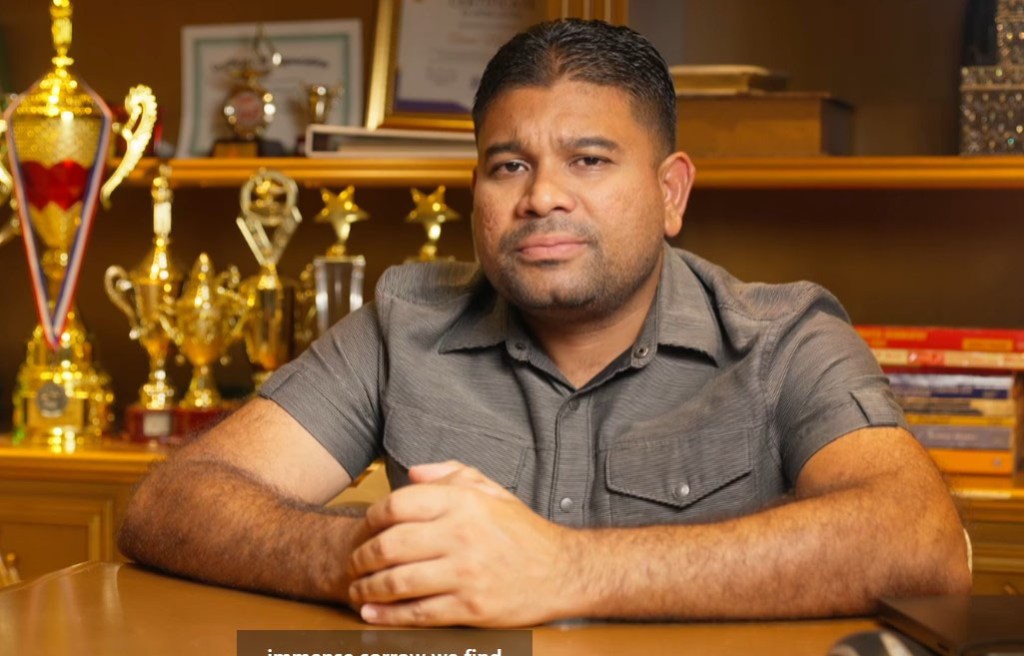
What was Azruddin Mohamed doing outside Prem Narine’s house at that hour? However you look at it, it was a stupid thing to do.
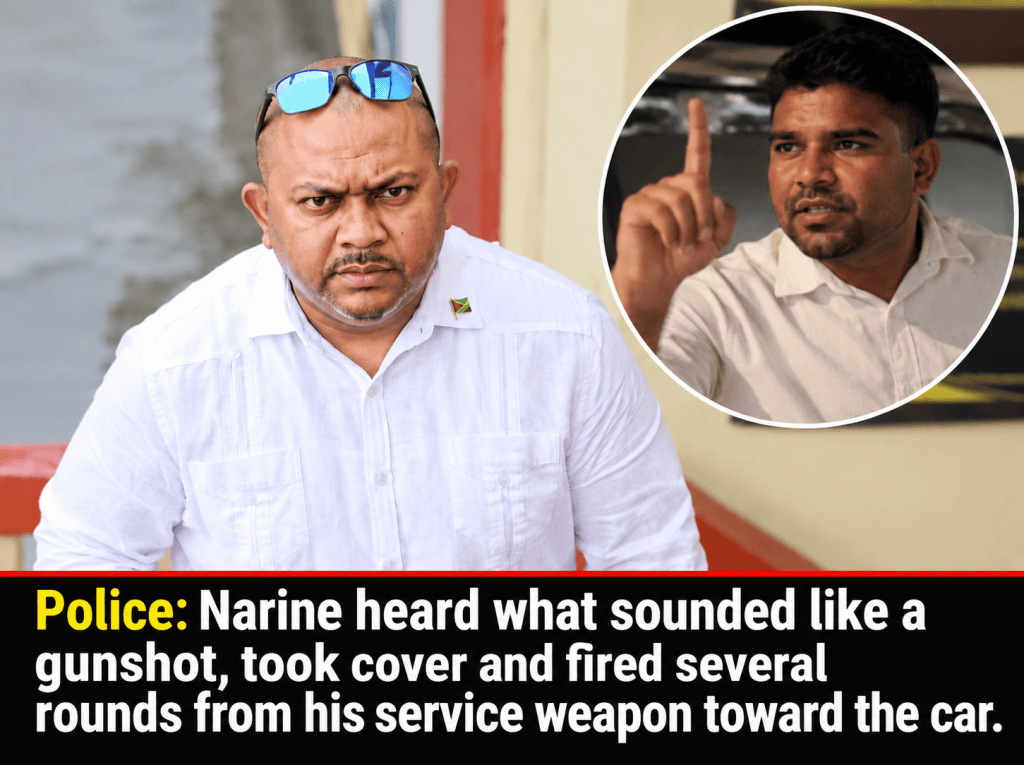
On the night of October 12, Mohamed, the Leader of the Opposition, was arrested after gunfire outside the Georgetown home of Senior Superintendent Prem Narine. Narine is Head of the Special Branch and a key witness in Mohamed’s extradition case. Police say Narine fired on the car after hearing what sounded like a gunshot, and that an unlicensed pistol was later found inside. Mohamed’s attorney says no shot was fired from that car. Before we ask what Mohamed was thinking, consider what has happened to other accused men who strayed too close to a witness.
In December 2023, a Massachusetts blogger named Aidan Kearney went to the home of his former girlfriend. She was a witness in a grand jury investigation that had already indicted him for witness intimidation. Prosecutors said he demanded her phone and shoved her. Kearney denied it and even played a recording of their conversation in court. It did not matter. The judge revoked his bail and sent him to jail.
In June 2018, Paul Manafort, once chairman of a US presidential campaign, was out on bail awaiting trial. Prosecutors said he had contacted two witnesses by phone and encrypted message. His lawyers called the evidence the “thinnest” imaginable and swore he never asked anyone to lie. Judge Amy Berman Jackson was unmoved. “I cannot turn a blind eye,” she said, and Manafort went to jail.
In August 2023, Sam Bankman-Fried, the FTX founder, sat under house arrest on a US$250 million bond. He never went near a witness. He never threatened anyone. Prosecutors said he leaked the private writings of a key witness to the New York Times. He claimed free speech. Judge Lewis Kaplan revoked his bail and remanded him to jail until trial.
Three men. Three denials. Three jail cells.
The lesson is simple, and every first-year law student knows it. Courts protect witnesses first and sort out guilt later. An accused man does not have to commit a crime to lose his liberty. He only has to give the court reason to believe a witness is at risk.
Guyana has seen this film before
This is not the first time. On September 3, police stopped a car carrying Mohamed near President Ali’s private home at Leonora after reports of a drone overhead. He denied any part in it and was never charged. The prosecution asked the court to revisit his extradition bail. Chief Magistrate Judy Latchman refused, saying the court must be guided by what can be proven, not what may be suspected.
That was the right ruling. But note what was before her: a political opponent’s home, a drone, and suspicion. There was no witness, no weapon, no gunfire. Six weeks later, Mohamed was outside the home of a key witness in his own extradition case, at night, in a car where police say an unlicensed pistol was found. That is no longer a matter of politics. It goes to the integrity of the very proceedings that granted him his liberty. A court that once gave him the benefit of the doubt now has far more than suspicion before it.
Georgetown, October 13
Return now to Narine’s home. The car that approached it was a black Toyota Allion. Police say they found an unlicensed .32 Taurus pistol with no serial number inside, along with Mohamed, Mario Mohamed and Eugene Thorne.
Mohamed’s attorney disputes that any shot came from that car. Let us grant him that. Let us assume, for the sake of argument, that Mohamed is telling the whole truth.
It changes nothing.
Not smart, even if innocent
Ask the question again: why was he there? This is a man the United States wants to try for an alleged US$50 million gold scheme involving fraud, bribery and money laundering. The police had already ordered him to surrender his personal weapons. Every move he makes is watched.
Kearney denied the shove. Manafort denied the tampering. Bankman-Fried called it free speech. Not one of their explanations kept them out of jail, because the courts never had to decide who was telling the truth. In those courts, being there was enough. Making contact was enough.
Mohamed exposed himself to every possibility. He gave a nervous officer a reason to fire. He gave the police a reason to arrest him. He gave the prosecution its best argument for the courts: that the accused has been found at a witness’s door. Even an innocent man in his position does not go there. Not at night. Not ever.
That is not the conduct of a strategist. Alternatively, it is the conduct of a man who believes the rules that govern other accused persons do not apply to him.
The extradition question
Some have suggested darker calculation. Section 26(3) of the Fugitive Offenders Act says the Minister cannot order a person’s surrender while that person is charged with an offence in Guyana. The bar lasts until the charge is disposed of. If the case ends in a prison sentence, it lasts until that sentence is served. A local charge, the theory goes, is a wall between Mohamed and the plane to Miami.
If there is a plan, it is not a smart plan
Read the same section to the end. Its proviso allows the Minister to order a temporary surrender: the fugitive is sent to the United States for trial, then returned to Guyana to face the local charge. The wall has a door in it, and the government holds the key.
What else does a firearms charge buy? Heavy prison time if convicted. A powerful argument against bail in every matter he faces. Damage to his standing with voters, with the courts, and with every international observer watching this case. If delay was the goal, a hundred cheaper roads led there. He chose the one that runs past a witness’s house with, by the police account, an illegal gun in the car.
A man who plans his way into a firearms charge to escape a fraud trial has not outsmarted the system. He has traded one set of handcuffs for two.
The larger cost
Whatever the truth, the office of Leader of the Opposition is the real casualty. That office exists to scrutinise a government drowning in oil money and to offer the Guyanese people an alternative. It was never meant to be a shield for one man’s legal troubles. Every day spent on Mohamed’s personal crises is a day the PPP is not held to account.
So I return to the question. Not very smart, or working to a plan?
If he is innocent, he was not smart. If he had a plan, it was not a smart plan. Either way, the answer is the same, and the Guyanese people are the ones paying for it.



Leave a Reply