
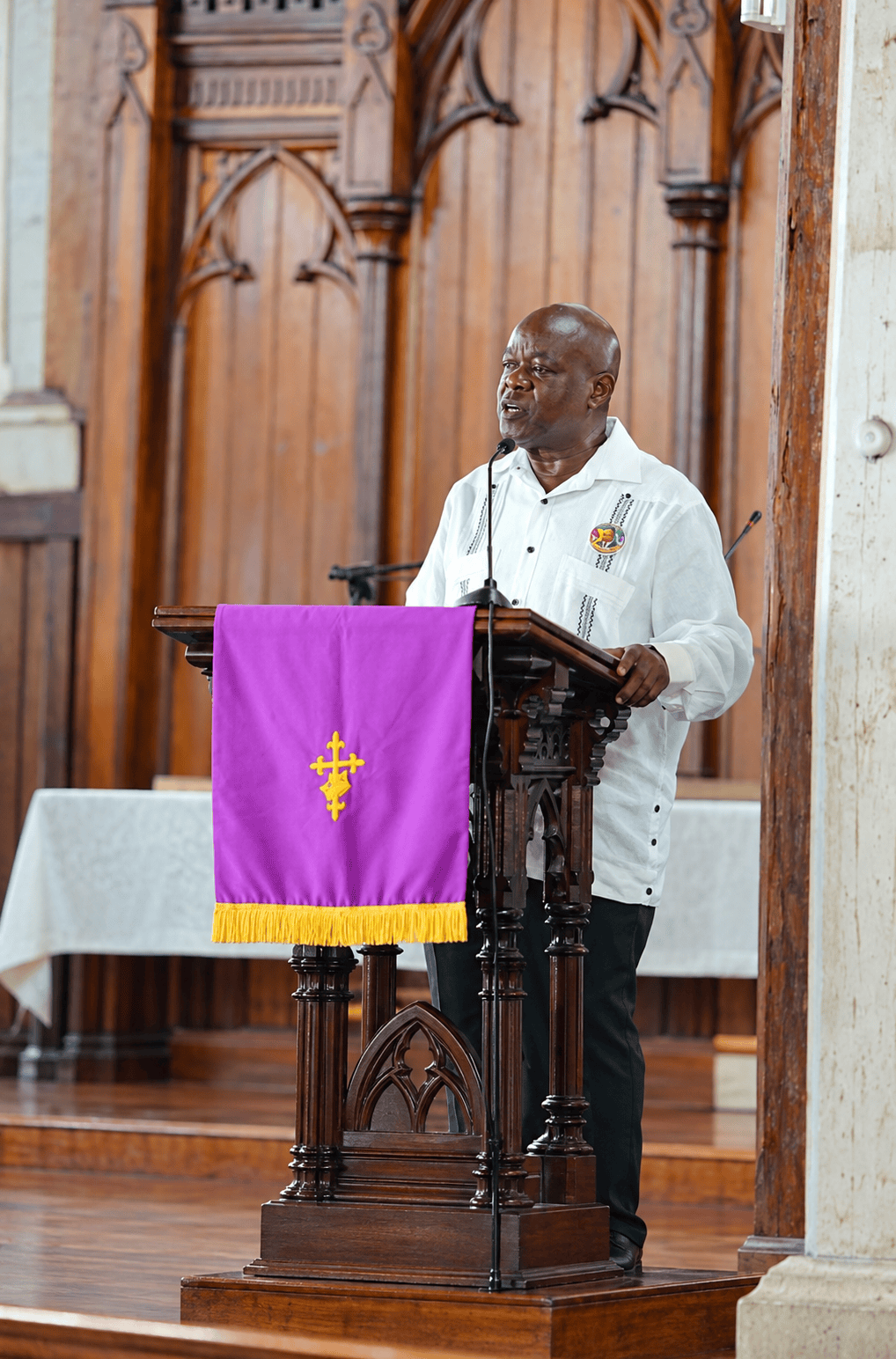
PNCR Leader Aubrey C. Norton announced at the funeral of former PNCR Leader Robert H.O. Corbin that the party will hold primaries to determine its presidential candidate for the 2030 General Elections.
The commitment builds on a pledge Norton made in June. Speaking on KAMSTV, the Working People’s Alliance YouTube channel, he ruled himself out as the presidential candidate for the elections constitutionally due by 2030, even if he remains party leader. He said the party needs a candidate who can relate to voters aged 35 and under, Demerara Waves reported on June 3. Primaries now give the party membership the final say on who that candidate will be.
The announcement was a fitting tribute. Corbin was the first PNCR Leader to institute primaries, a policy he championed for years. Ahead of the 2011 elections, he publicly insisted that the presidential candidacy would be decided by the party, not by him. In that contest, retired Brigadier David Granger defeated former Finance Minister Carl Greenidge to become the party’s presidential candidate.
The results vindicated the process. Leading the newly formed A Partnership for National Unity (APNU) at the November 2011 General Elections, Granger secured 139,678 votes (40.8 per cent) and 26 seats. The PPP/C, under Donald Ramotar, won 166,340 votes (48.6 per cent) and 32 seats, while the Alliance For Change took 35,333 votes (10.3 per cent) and seven seats. For the first time since 1992, the PPP/C held the presidency without a majority in the National Assembly. The combined opposition controlled 33 of the 65 seats.
That one-seat opposition majority set the stage for what followed. Facing a no-confidence motion in November 2014, President Ramotar prorogued Parliament and later called early elections. APNU and the AFC formalised their partnership under the Cummingsburg Accord in February 2015, with Granger as presidential candidate and Moses Nagamootoo as prime ministerial candidate.
At the May 11, 2015 General Elections, the APNU+AFC coalition won 207,200 votes (50.3 per cent) and 33 seats, against the PPP/C’s 202,694 votes (49.2 per cent) and 32 seats. The margin of roughly 4,500 votes ended 23 consecutive years of PPP/C rule. Granger was sworn in as Guyana’s ninth President on May 16, 2015.
Norton’s commitment to primaries for 2030 returns the party to the democratic model Corbin established, one that produced a candidate capable of first denying the PPP/C its majority and then removing it from office.


Leave a Reply