
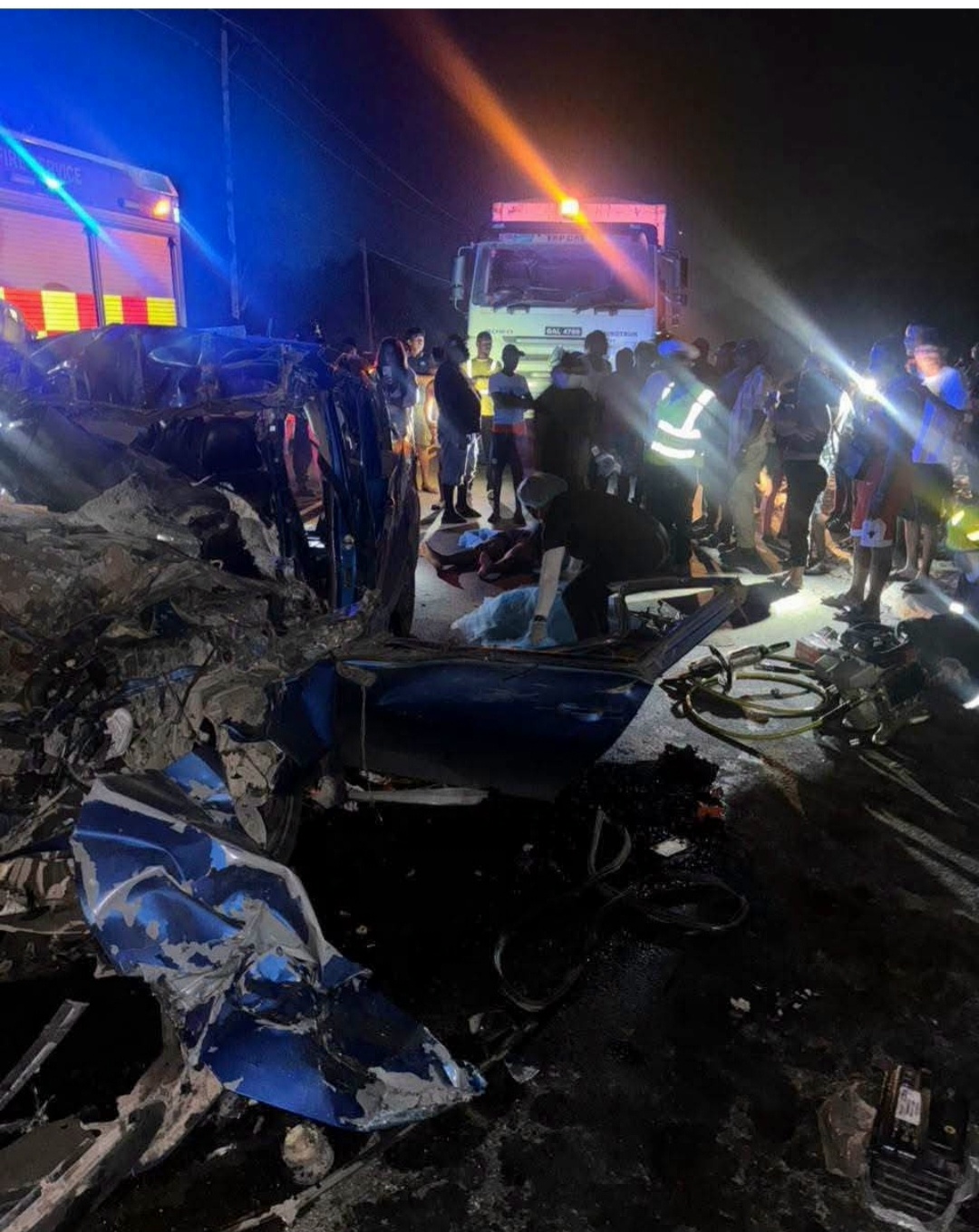
Four people are dead and three others are reported critical after a motorcar carrying seven occupants collided with a heavy-duty fuel truck near Long Creek on the Soesdyke-Linden Highway on the night of Friday, October 23, 2026. It is the latest in a string of multi-fatality crashes on the corridor.
What we know
One female and three males died, and the car was reduced to a mangled heap of metal. Preliminary information, which police have not confirmed, is that the car was travelling at a high rate of speed when it struck the rear of the fuel truck.
Guyana Fire Service personnel and police were on the scene. Photographs circulating on social media show the crushed car, emergency lighting, and a large truck stopped beyond the wreckage with a crowd gathered around it.
Not yet public: the names and ages of the dead and injured, the exact time of the crash, whether the fuel truck was moving or stationary, and any official statement from the Guyana Police Force. This article will be updated when police release those details.
A corridor with a record of mass-casualty crashes
Tonight’s crash follows at least five other serious collisions on the highway since May 2024.
| Date | Location | What happened | Deaths |
|---|---|---|---|
| Nov 16, 2025 | Silver Hill | Two cars collided in the evening; five others injured, several of them children | 2 |
| Sep 2025 | Hill Foot | Car and lorry collided about 2:00 am; two passengers hurt | 1 |
| Late Aug 2025 | Near Loo Creek | Two lorries collided head-on and one caught fire; a woman was trapped and burned | 3 |
| Aug 16, 2025 | Near Loo Creek | Car struck a parked lorry with a blown tyre and no reflectors or warning signals; a young child was among the dead | 3 |
| May 13, 2024 | Long Creek | Head-on collision of two cars; five died that day and a sixth later in hospital | 6 |
The 2024 victims included two teachers and a retired nurse. After that crash, a local official said accident victims on the route must wait for personnel to arrive from Linden or Diamond, and called for a health facility with an emergency department and a fire station on the highway.
Road safety in Guyana: the numbers
Guyana’s police recorded 124 fatal accidents and 137 road deaths in 2025, including six children and 53 motorcyclists. The Ministry of Home Affairs put 2024 at about 154 deaths, a 14 per cent drop from the year before. From 2014 to November 2, 2024, the country logged 1,212 fatal accidents and 1,370 deaths, 83 per cent of them male, with people aged 25 to 42 the most affected.
The first half of 2026 shows a split picture, according to police figures:
| Measure, Jan–Jun | 2025 | 2026 |
|---|---|---|
| All road accidents | 783 | 580 |
| Fatal accidents | 59 | 58 |
| Deaths in 2026 | not stated | 64 |
| Fatal crashes caused by speeding | 52 | 43 |
| Fatal crashes linked to inattentiveness | 6 | 12 |
| Pedestrian deaths | 12 | 17 |
| Speeding tickets issued | under 14,300 | 18,874 |
Beyond the country’s own figures, more than 1.2 million people die in road crashes worldwide each year. The World Health Organization’s Global Status Report estimated Guyana’s death rate at 24.6 per 100,000 people in 2016, up from 17.3 in 2013. Its 2018 report put the United States at about 12 per 100,000.
Official targets differ: the Home Affairs Ministry has cited a goal of no more than 53 deaths a year by 2030 in one statement and 65 in another. Both are well below the 137 recorded in 2025, but neither is zero. Other places have set zero as the goal. A number of US states have adopted targets of zero traffic deaths and serious injuries, with deadlines in 2030 and 2040. A target of 53 deaths a year accepts that dozens of Guyanese families will lose someone on the road every year, and it falls short of that standard.
What keeps killing people on the road
Speeding is the leading factor. Of the 58 fatal crashes in the first half of 2026, 43 involved speeding. Driver inattentiveness doubled, from six cases to 12, and the Traffic Chief singled out personal distractions as an increasingly dangerous factor.
Time and place matter too. Evenings between 6:00 pm and midnight saw 28 of the fatal accidents, and Saturday was the deadliest day with 14. Adults aged 25 to 42 accounted for 36 of the 64 deaths in that period.
Vulnerable road users carry a heavy share. A peer-reviewed study of Georgetown and the coast to its east found that 53 per cent of fatalities involved a non-motorised user struck by a motor vehicle, with pedestrian-vehicle collisions the most common fatal type at 35 per cent. Police say pedestrian deaths are one of their greatest concerns this year.
The road itself is part of the problem
Guyana talks a lot about bad drivers and far less about bad roads. A road is supposed to forgive mistakes. On a dark highway, it often does not.
Start with vehicles left in the road at night. On August 16, 2025, near Loo Creek, a lorry with a blown tyre was left on the roadway with no reflectors or warning signals, and a car ran into the back of it, killing three people. Tonight’s crash was also a rear impact with a large truck. Police have not said whether the fuel truck was moving or stopped, and that question matters. At night a driver can only stop within the distance the headlights show, and a dark lorry at highway speed leaves almost no time. Evenings between 6:00 pm and midnight accounted for 28 of the 58 fatal crashes in the first half of 2026.
A broken-down truck needs somewhere to go. That means a proper shoulder or a lit lay-by, so it is not stranded in the travel lane. It also means reflective triangles, reflective tape on lorries, hazard lights, quick towing, and real penalties for owners who leave vehicles on the carriageway. It is not clear which of those rules exist for this highway or how often they are enforced. Police should be asked.
The surface matters too. Potholes show up in Guyana’s own crash reports. In the late-August 2025 collision near Loo Creek, the lorry driver told police a car ahead braked suddenly to avoid one. Studies in several countries have found that crash rates climb once a road becomes rough enough. A headline has reported $5B to rehabilitate the East Bank Demerara road and the Soesdyke-Linden Highway. Whether that work also gives the road usable shoulders, clear sight lines, lighting and a smooth surface will help decide whether the corridor gets safer.
No published information on the highway’s design turned up in research for this article, including its design speed, shoulders or sight lines. Whether it meets accepted standards is a question for the Ministry of Public Works. Guyana has no published standard of its own that turned up, and the US Federal Highway Administration’s criteria are a model worth adopting: roads designed for the speed limit posted on them, with usable shoulders and enough visible distance for a driver to stop.
Engineering is the missing factor
Enforcement and driver education are necessary, but they are not enough. The Police Commissioner has said as much. The goal also needs to be higher: Guyana will not get from 137 deaths a year to zero, or even to its 2030 target of 53 to 65, without changing the roads themselves.
US states that have adopted zero goals show what that changes. Their plans are built on a safe-system approach: safer roads, safer speeds, safer vehicles and better care after a crash, not just safer drivers. Some have mapped the stretches of road where deaths and serious injuries concentrate and published the data on public dashboards, so officials and residents can see the worst spots for themselves. Guyana’s police already collect the crash records to do something similar.
Engineers have a toolkit of low-cost measures that have cut crashes elsewhere. Grooved strips down the centre line that rumble when a car drifts across have cut head-on crashes causing injury or death by about 44 per cent on rural two-lane roads in US studies. The same strips on the shoulder cut run-off crashes by about 36 per cent. Wider, brighter edge lines and chevron signs on bends help drivers see where the road goes at night. On divided stretches, a barrier down the middle all but ends cross-over crashes. Roundabouts in place of stop-controlled junctions sharply cut fatal crashes. Where people cross the road, refuge islands and beacons cut pedestrian crashes by half or more, which is worth noting when pedestrian deaths rose from 12 to 17 in the first half of this year.
Others are simpler: lighting at junctions and villages, speed bumps, rumble bars and gateways where the highway runs through a community, fewer side roads and driveways opening onto the highway, guardrails at canals and culverts, and lit lay-bys and truck parking. The 21 speed cameras in Regions Three and Four show that Guyana already accepts the principle of using technology to slow drivers. Design can do the same without a ticket. And a fire station and health facility on the route, which a local official asked for after the 2024 Long Creek crash, would shorten the wait for help.
The way to decide what goes where is a road safety audit. Engineers drive the corridor, map where crashes cluster using police records, and fix the worst spots first. Long Creek and Loo Creek have both had multi-fatality crashes within the past two and a half years, so they are obvious places to start. The findings should be made public.
One caution: the percentages come from studies in other countries and will not carry over exactly. That is why each fix should be chosen from Guyana’s own crash data rather than copied wholesale.
Enforcement is growing, but fatalities persist
The police have switched on 21 speed cameras in Regions Three and Four, with expansion planned, and credit enforcement and technology for a 24 per cent fall in accidents so far this year. The Traffic Chief says the Safe Road Intelligent System will extend to other areas once major road works finish. A traffic management framework is planned under the Police Strategic Plan 2027-2031.
Yet fatal crashes barely moved in the first half of 2026, from 59 to 58. In 2025, the chairman of the Guyana National Road Safety Council, Earl Lambert, asked whether e-ticketing, speed cameras and body cameras were enough, and proposed a “three-strike” system for repeat offenders. Police Commissioner Clifton Hicken said enforcement alone would not solve the problem and that road safety is everyone’s responsibility.
For the Soesdyke-Linden corridor, the questions that follow tonight’s crash are whether speed enforcement reaches the highway, whether heavy-vehicle parking and lighting rules are enforced, and whether emergency services can reach crash scenes faster.


Leave a Reply