
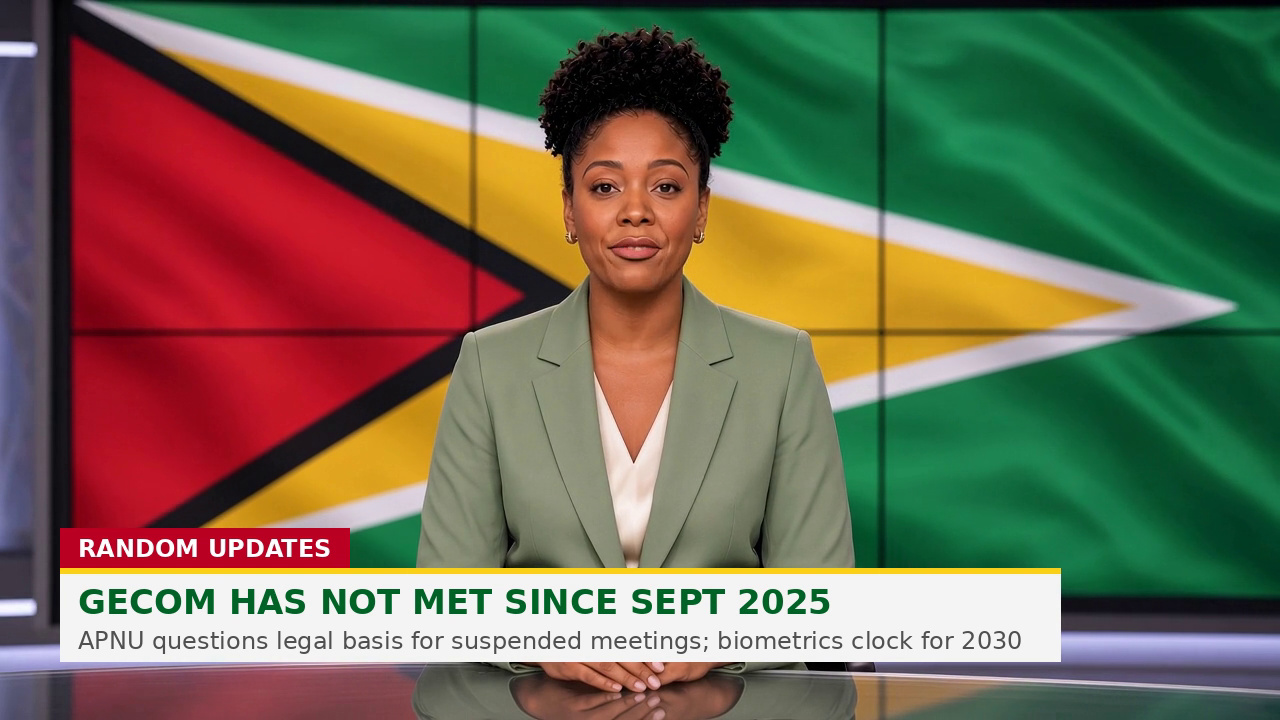
Yesterday, A Partnership for National Unity (APNU) held its weekly press conference, at which it addressed the issue of what it called Justice (Ret’d) Claudette Singh’s illegal suspension of meetings of the Guyana Elections Commission. The party also took up the Gaming Authority Bill and the benefits proposed for former presidents.
The Commission has not met since September 2025. That is not in dispute; GECOM itself has acknowledged it. What is in dispute is why, and what the silence is costing the country. APNU first put the question to the GECOM Chair in a statement on Wednesday, November 11. At yesterday’s press conference, APNU leader Aubrey Norton said the party would explore all options, including judicial review.
The Chair's reason, and APNU's reply
GECOM’s position, as set out in a statement issued on Tuesday, November 10, is that its Chairman remains guided by Article 161(3)(b) of the Constitution, which governs how Opposition-nominated commissioners are appointed. The Chair’s reason, as APNU describes it, is that she is waiting for commissioners nominated by the new Leader of the Opposition to be seated. After the September 2025 elections, We Invest in Nationhood (WIN) became the largest opposition party with 16 seats to APNU’s 12, and Opposition Leader Azruddin Mohamed has submitted his own three nominees. President Irfaan Ali has not acted on them.
APNU’s argument is that GECOM’s own statement undercuts that reasoning. The Commission said legislative attention could help resolve the question of its composition. APNU reads that to mean the composition cannot change without a law, and that the sitting commissioners therefore remain lawfully in office and could have been meeting all along. “APNU maintains that the suspension has no basis in law,” the party said. Norton described GECOM as a permanent commission and said the commissioners are legally there.
It is the Commission itself that has said legislative attention could help resolve the question of its composition. If the Commission says legislation is needed, is it not thereby admitting that the current Commission is fully constituted? On what lawful basis can meetings of a constitutional body be withheld? APNU says the refusal to call meetings of a constitutional commission is illegal.
There is another side. GECOM says the lack of meetings should not be confused with the institution not functioning, and that its Secretariat continues registration and other statutory work. It concedes that matters needing collective decisions cannot be considered. President Ali said on Friday that the courts are there for any party that wants the issue settled, and ruled out an immediate constitutional amendment on GECOM’s composition. He also said Local Government Elections, due this year, will not be held.
Why biometrics is the real clock
For APNU, the damage is bigger than procedure. The party says more than a year has been lost from the time available to prepare for the 2030 elections, particularly to introduce biometric verification of voters, and says it is “alarmed” that this could be an effort to run down the clock.
The record shows why timing matters. In January 2025, Justice Singh ruled that a full biometric system was not feasible for that year’s elections, citing the time left, procurement, staff training, public education and the need for legislation. The same ruling found no legal barrier to digital fingerprint capture at registration, and said biometric identification could be an additional tool at the place of poll if legislation were passed. Procurement, policy and training all call for decisions by the Commission.
So the questions stand. What is the exact legal basis for not convening a Commission that, APNU notes, GECOM itself treats as lawfully constituted? Who benefits as time runs out on biometrics? And will Guyanese hear again, as 2030 approaches, that there is simply not enough time? GECOM has announced no date for the Commission to resume meeting.
The gaming bill: who can afford a licence?
APNU also weighed in on the Gaming Authority Bill 2026 (Bill No. 12), which the National Assembly sent to a special select committee on Wednesday, November 11. APNU says it backs regulation to protect children and the vulnerable, tackle addiction and stop money laundering. Its concern is cost and proportion.
Under Schedule Two, a betting shop operator’s licence carries a G$30 million application fee and a G$30 million annual fee. A betting shop premises licence has separate G$2 million application and annual fees. Remote gaming operators face G$250 million to apply and G$250 million a year. Agents pay a G$500,000 application fee with no annual fee. Kiskadee Watch, reporting on the bill when it was tabled in July, put casino operators at a G$5 million application fee and G$4 million a year.
APNU says these are different categories and must be examined separately. Its warning is that very high entry costs could reserve the market for the largest operators and push small ones outside the regulated system. On penalties, the bill proposes fines of G$2 million to G$10 million on summary conviction for taking part in unlicensed gaming. APNU asks how fines that size would help a vulnerable person already in gambling-related hardship.
The Government’s stated aim, per the Department of Public Information, is a single regulator with stricter oversight, and the committee gives operators, churches and addiction specialists a forum before the bill returns to the House. No membership or timetable has been announced. Do fees of this scale reflect the cost of regulation? That is a fair question for the committee.
Ex-presidents' benefits against a G$102,346 wage
The third APNU statement concerns the Former Presidents (Benefits and Other Facilities) Bill 2026 (Bill No. 10), which would repeal the 2015 Act. The bill covers utilities, household and administrative staff, medical care for former presidents and dependants, security, state-maintained vehicles, vacation travel and tax exemptions. APNU says several categories carry no monetary ceiling. The Government’s position, put by Attorney General Anil Nandlall, is that the 2015 law was flawed and the bill restores a consistent framework. News Source Guyana reported that under the 2015 Act utility allowances were capped at G$75,000 a month, against an uncapped amount averaging about G$370,000 a month for former President Bharrat Jagdeo. Debate was deferred on November 11 to the next sitting, November 18. No reason was given publicly.
APNU says former presidents should have benefits suited to the dignity of the office, including reasonable support and security, but within enforceable limits. It then draws a contrast. The party cites a G$102,346 basic monthly public service wage, the figure in its November 5 letter seeking a rise of at least 25%, retroactive to January 2026. And it points to Linden, where residents protested on November 2 over blackouts reported to have lasted more than 30 hours and the water outages that follow. “Citizens are entitled to ask,” APNU says, why open-ended benefits for a few should command attention while basic needs remain unresolved.
Whether the comparison is fair is for readers to judge, since the bill and the wage claim are separate matters with separate costs. But if the 2015 limits really are out of date, as APNU itself allows, would it not be reasonable for the evidence and the costs to be laid out openly?
What to watch
The National Assembly sits again on November 18, when the Former Presidents Bill is due back. The gaming bill’s select committee has yet to be formed. And on GECOM, the questions about when the Commission will meet again, and on what legal footing it has not, remain open. This publication will keep asking them.

Leave a Reply